
This guide was built from government advisories (US State Dept, UK FCDO, Australian Smartraveller), official statistics where they exist, and local news sources. See methodology →
Quick Safety Summary
What Nobody Tells You
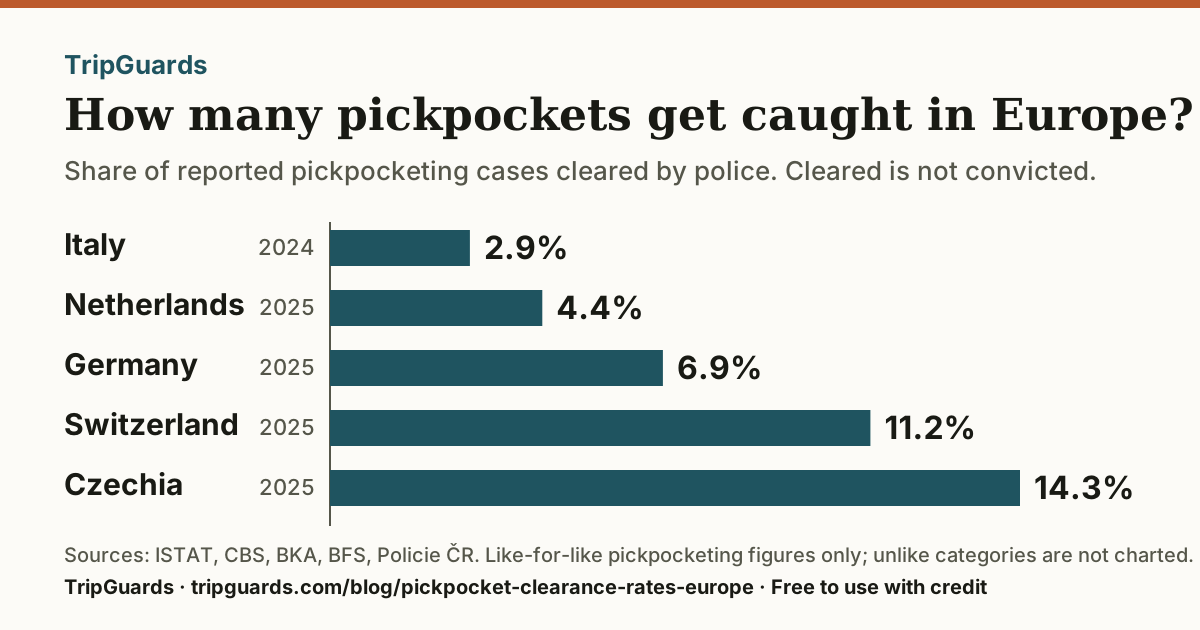
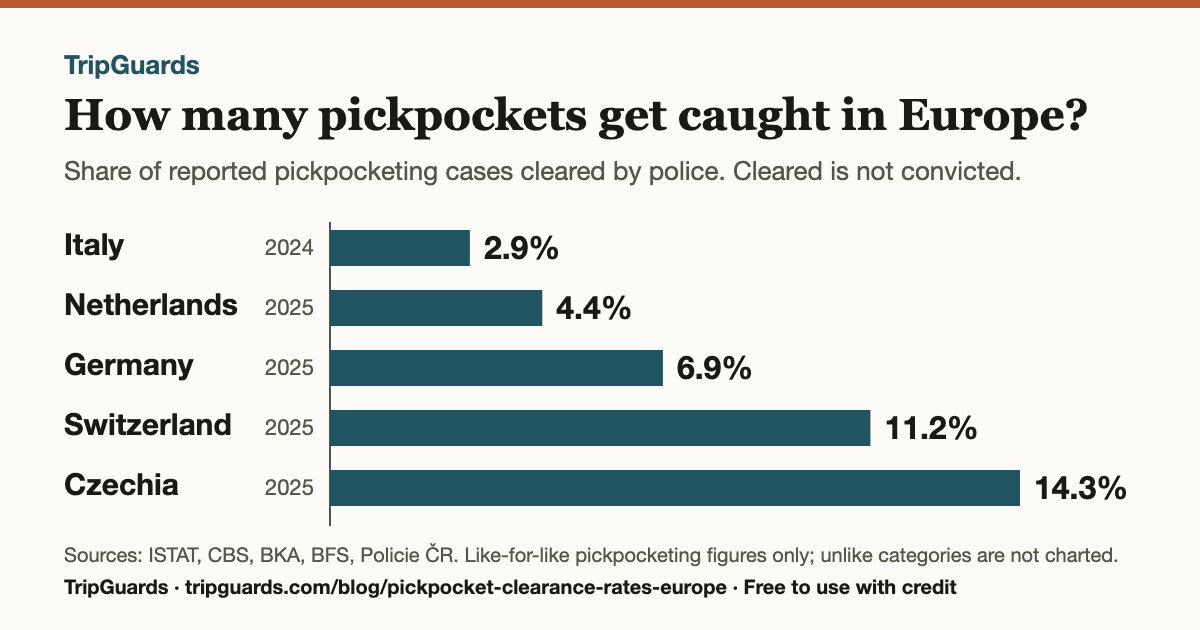
1. The Comparable Table: Five Countries, Pickpocketing Only
A clearance rate is the share of recorded crimes that police mark as solved, which in most systems means a suspect was identified, not that anyone was convicted. For pickpocketing the number exists, but it sits deep inside national tables, in several languages, and we could not find it collected anywhere. So we went through the official sources for 13 European jurisdictions and read each figure at source on 5 November 2026. Five countries publish a pickpocketing-only rate on a police-clearance basis. Those five can be ranked, with the caveats that follow. Italy, 2.9%: ISTAT counts 140,792 furti con destrezza reported in 2024, of which 4,109 had a known alleged offender by the end of the year. That is up slightly from 2.7% in 2023. ISTAT publishes the same measure by city: in Milan it was 1.7% in 2024, 368 of 21,215. Netherlands, 4.4%: CBS counts 7,485 cases of zakkenrollerij in 2025, with 330 cleared. Germany, 6.9%: the BKA counts 95,184 cases of Taschendiebstahl in 2025 and 6,602 cleared. The rate was also 6.9% in 2024, on 7,425 cleared of 107,720. Switzerland, 11.2%: the Federal Statistical Office counts 9,555 cases of Taschendiebstahl in 2025, up from a 9.8% rate on 11,304 cases in 2024. It publishes the rate but not the number cleared. Czechia, 14.3%: Czech police recorded 3,384 pickpocketing offences in 2025 and cleared 483 of them, against 13.3% in 2024 (555 of 4,161). The highest rate is about five times the lowest. Even so, the top of this table clears one case in seven, and the bottom clears about one in 34. Definitions of "cleared" are close rather than identical: the Dutch, Swiss and Italian sources describe a suspect or author being identified, Germany counts "aufgeklärte Fälle", and the Czech table gives the term objasněno without defining it. Reporting habits differ too, so a gap of a point or two should not be read as a difference in police performance.
| Country and year | Clearance rate |
|---|---|
| Italy 2024 | 2.9% |
| Netherlands 2025 | 4.4% |
| Germany 2025 | 6.9% |
| Switzerland 2025 | 11.2% |
| Czechia 2025 | 14.3% |
Pickpocketing only, police clearance, not convictions. Bars are to scale from zero. Italy is 2024, the others 2025. Sources: ISTAT, CBS, BKA, BFS, Czech police.
Not charted: Austria, France, Sweden and England and Wales publish figures for a different category or a stricter measure, so they cannot share this scale. Portugal, Denmark and Spain publish no pickpocketing rate.
Free to use with credit: SVG or PNG. Please credit TripGuards and link to this page.
2. The Rates That Must Not Be Ranked With Them
Four more official figures appear in discussions of this subject. Each is real, and each measures something different, so we keep them out of the ranking. Austria, 10.5%: the Federal Criminal Police Office reports 9,105 cases in 2025 and 10.0% on 9,849 cases in 2024, but for Taschen- und Trickdiebstahl, which merges pickpocketing with trick theft. That matters, because Switzerland splits the two: its trick theft rate is 30.3% against 11.2% for pickpocketing. Austria's pickpocketing-only rate may therefore sit below 10.5%, but it is not published. France, 7%: SSMSI reports that 7% of "vols sans violence contre des personnes" recorded in 2024 were solved within twelve months, and 5% within three. The figure is rounded, no case count sits beside it, and the category is wider than pickpocketing. Earlier SSMSI reporting, which this site used to quote, put it at under 7%. Sweden, 1.1%: Brå publishes a pickpocketing-only figure, fickstöld, at 1.1% for both 2024 and 2025. It looks like the lowest in Europe, but it is a stricter measure. A Swedish offence counts as personuppklarat only after a decision to prosecute, a penalty order, a waiver of prosecution or a caution, and the base is every handled offence, including those written off without investigation. The rate describes a much later stage of the process than a suspect being named. England and Wales, 1.0%: of 121,052 thefts from the person recorded across all forces in the year to March 2026, 1,170 had been charged or summonsed when the Home Office open data was last updated in October 2026. That is our calculation. It covers offence code 39, which is not limited to pickpocketing, and it counts charges rather than suspects identified. The more telling number in the same data is that 104,855 of those offences, or 86.6%, closed with no suspect identified.
3. No Published Rate: The Absence Is the Finding
Three countries with heavy tourist traffic give a traveler no answer at all. Portugal counts its pickpocketing carefully: the Annual Internal Security Report (RASI 2025) records 7,443 reports of furto por carteirista, up 7.7%, and gives the share by district. It gives no clearance rate. PSP, the city police, has reported 134 pickpockets detained in 2025, but people detained and cases solved are different counts, so we do not divide one by the other. More in our Lisbon deep-dive. Denmark's public statistical tables, STRAF10 and STRAF20, sort reported offences and charges into 91 types, and pickpocketing is not one of them. Statistics Denmark has published pickpocket and bag theft report counts from special extracts, but we found no matching figure for charges. Spain's Interior Ministry yearbook has one line for all hurtos, meaning every theft without force. The 2023 edition, the latest we could open, lists 665,622 known and 132,759 cleared, which is 19.9% by our division. That is not a pickpocketing rate, and it should not be quoted as one. The Czech and Swiss tables show why: shop theft clears at 88.5% and 86.4% there, and a catch-all category that includes it will look far better than pickpocketing alone. The Basque police supply no cleared data to the national total, so the ratio may also be understated. The 2024 yearbook page refused our connection, so the 2023 figures may have been superseded. Belgium is unverified. Both official portals failed to open on the day we checked, one showing a maintenance page and the other not resolving. We are not saying a Belgian rate does not exist, only that we could not confirm either way.
4. Prague Against the Rest of Czechia
The most useful single comparison in this data is inside one country, because the definitions and the police force are the same on both sides. In 2025 Prague recorded 2,124 of Czechia's 3,384 pickpocketing offences, or 62.8%, and cleared 164 of them: 7.7%, about one in thirteen. Everywhere else in the country combined, police recorded 1,260 and cleared 319: 25.3%, about one in four. The pattern is not a one-year blip, because Prague cleared 7.3% in 2024 (199 of 2,737). One plausible explanation is that a tourist pickpocketed in Prague leaves within days, while a local victim elsewhere can still be reached to give evidence. That is our reading, not a finding: the police table does not break victims down that way. It is not a rule for tourist cities, though. Amsterdam runs the other way: CBS gives it 5.3% (160 of 2,980), above the Dutch national 4.4%. These tables cannot say why the two cities differ. Our Amsterdam deep-dive goes further into that city.
5. What This Changes, and How to Use the Data
This study replaces a neater claim. Our own statistics hub was built when we had three rates, from the Netherlands, Germany and France, all between 4% and 7%, and described that as a band every publishing country falls within. Going through the wider set shows that it does not hold. Comparable rates run from 2.9% to 14.3%. Italy also does publish a rate, which the hub had said it does not. The narrower point survives: no country with a comparable national figure clears more than about one reported case in seven. Three cautions if you quote any of this. Every denominator counts reported or handled offences rather than thefts, and tourists report least, so a country where reporting is easier may look worse. Rates can rise simply because reports fall, and Switzerland, Czechia and Austria all recorded fewer cases in 2025 while their rates rose. And none of these figures counts convictions. The practical point does not change. Report a theft for your insurer and for the record, then act as if the item is gone: what to do if you are pickpocketed covers the first ten minutes. The full dataset is free to download: pickpocket-clearance-rates-europe.csv, with country, scope, year, reported, cleared, rate, exact category and source URL for every row. It is licensed CC BY 4.0, so please credit "TripGuards, How Many Pickpockets Get Caught in Europe?" and link to this page. If a statistics office publishes a figure we missed, tell us and we will add it.
A police report is only half of a successful claim. Four things worth reading in your own policy wording before a trip — they are where theft claims usually fail:
- Is theft of belongings covered at all? Medical-only policies and many credit-card inclusions cover treatment and cancellation but not stolen possessions. Look for “personal possessions” or “baggage” as a named section.
- What is the single-item limit? Policies commonly cap any one item well below the price of a current phone, so a stolen handset can be reimbursed at a fraction of its value. Check whether you can name a high-value item to raise it.
- How quickly must you report it? Many policies require a police report within 24 hours. This is the practical reason to file before you fly rather than after you land.
- Are unattended items excluded? Most policies exclude anything left unattended — a bag on a beach towel or a phone on a café table is often not covered even with a report in hand.
No cover yet? We use SafetyWing — check the possessions section against the four points above, because it suits some trips and not others. Affiliate link; how we handle these.
Final Verdict
Frequently Asked Questions
There is no European figure. Among the five countries with a comparable pickpocketing-only rate, it runs from 2.9% in Italy (2024) to 14.3% in Czechia (2025), with the Netherlands at 4.4%, Germany at 6.9% and Switzerland at 11.2%. These count cases where police identified a suspect, not convictions, and they count reported cases rather than all thefts.
Of the five with comparable figures, Czechia has the highest rate at 14.3%, clearing 483 of 3,384 cases in 2025. The rate splits sharply: 7.7% in Prague against 25.3% in the rest of the country. Spain's 19.9% is not a pickpocketing rate, because it covers all theft without force.
Because Brå measures something stricter. A Swedish offence counts only after a decision to prosecute, a penalty order, a waiver of prosecution or a caution, and the base includes offences written off without investigation. Most other countries count a suspect being identified, so 1.1% should not be ranked against them.
The Home Office does not publish a pickpocketing-only rate. Its closest category is theft from the person, for England and Wales only. In the year to March 2026, by our calculation from its open data, 1,170 of 121,052 offences were charged or summonsed, about 1.0%, and 86.6% closed with no suspect identified.
No. In most of these systems a case is cleared when police identify a suspect. Prosecution and conviction are later stages, and many cleared cases never reach them. Sweden's and England and Wales's figures show how much smaller the number gets at those later stages, even though the two are not comparable with each other.
Yes. The CSV at tripguards.com/data/pickpocket-clearance-rates-europe.csv is free to use under CC BY 4.0: please credit TripGuards and link to this page. Each row carries the exact category and source URL. Rows marked NOT RANKED use a different category or measure and should not be compared with the LIKE-FOR-LIKE rows.